Well, Google has done it again! The Google Art Project is by far the coolest thing I’ve come across so far this year.
By way of the same technology that Google uses to create its 360 degree street view navigation on Google Earth, we are now able to browse the rooms of some of the worlds greatest art galleries! Below is the screen that shows up when we choose the Uffizi Gallery in Florence for instance.
The large background image is a close up sample of one of the museum’s featured works - in this case Botticelli’s “Birth of Venus” from 1486. The navigation on the left enables us to either enter the gallery, explore the featured painting further, or choose another museum all together. Below is the view you will see in one of the rooms of the Uffizi.
Now that’s pretty sweet, but to me the best feature by far is that we can “walk” up to a work of art and zoom right in on it. Depending on your internet connection speed, it may take a few seconds for the full resolution version to render on your monitor, but when the thing is done it’s glorious hi-resolution detail is amazing! “The Birth of Venus” measures 67.9 inches by 109.6 inches so the thing is pretty big. Here is the entire painting.
Now look at the detail of the painting in the Google image below.
This is not even at full zoom either. Not only can we see the actual surface texture and how thinly the paint was applied, but, because Google gives us the opportunity to zoom in so close with such good quality, we can see that Botticelli probably made some revisions to his painting as it developed. He may have either moved the male face (of the west wind blowing Zepher) to the left, or decided to give him less hair as he was composing this portion of the painting.
We guess this because we notice the ghostly shadow along the temple of the female face (the nymph Chloris) which was probably the first pass the artist made at positioning the male head. This darkness is there because when a painting is this old it begins to lose its opacity a bit, especially if it was executed with thin paint to begin with. I hope your monitor allows you to see this in the image above.
Here is another extreme close-up of another part of the painting. We can see what is called the “craquelure”, or pattern of cracks in Venus’ calf.
So this thing that Google has given us is scary good in my opinion. They will be adding more museums in the coming months as well, so we can spend even more time marveling in front of our computers. Click the learn More link and watch the short videos on this great Google Art Project. AMAZING.
joe@joewinklerart.com | JoeWinklerArt.com
P.S. My sketchbook remains on display this week at the Brooklyn Art Library in NYC!
February 24, 2011
February 22, 2011
Today’s Featured Sketch and Fruity Inspiration
The subject of today’s sketch is natural light from above illuminating a pealed orange. It is from my Sketchbook Project sketchbook and it was done from reference I shot. It’s also one of the very few times I opted for a colored pencil drawing over an oil painting.
In an attempt to eat healthy, especially during the work day, I always have what amounts to a classic still life setup on the counter directly behind me. (Today’s is pictured below). This classic still life usually consists of a few bananas, some apples, grapes, and oranges. Sometimes it takes every ounce of restraint I can muster to keep from turning my back on more pressing issues and start sketching or at least photographing the lovely forms of these succulent delights before I consume them.
One very sunny summer morning last year I just couldn’t help myself, and before pealing the cover off this beauty, I whipped out my camera and began composing some shots. I placed a white napkin on a stool, positioned it in the shaft of brilliant sunlight streaming in through a nearby skylight, partially pealed the orange, placed it on the napkin and shot away.
I think a partially pealed orange is visually alluring because of the interesting organic shapes and the play of light and shadow that the skin creates when it’s in bright light. Additionally there were some great cast shadows too.
Next I pealed the orange all the way and took a few shots. Not so interesting that. Although the cast shadow thing began to intrigue me more and more.
Then I started slowly cracking her open while continuing to shoot. I decided to pull one section out further than the rest and - Viola! An interestingly shaped subject which had plenty of highlight, mid-tones, shadows and reflected light, and even a compelling cast shadow. The fact that it somewhat subliminally looks like a hand or claw with an outflung appendage makes it all the more pleasing.
Finally, after processing the digital picture up really right to use as reference, I decided to do it up in colored pencil. Perhaps a mistake that. I can convey luminous light way better in oils than I can in pencil. I’ll probably put this in the “to do” category in my head for a future oil painting.
I had a tough time deciding on a crop. I probably should’ve cropped more of the top off and made the focus on just the cast shadow. Or done the opposite and focused on the orange itself. Ah well, another issue to solve in the oil painting version someday.
Well, That’s lunch!
joe@joewinklerart.com
JoeWinklerArt.com
In an attempt to eat healthy, especially during the work day, I always have what amounts to a classic still life setup on the counter directly behind me. (Today’s is pictured below). This classic still life usually consists of a few bananas, some apples, grapes, and oranges. Sometimes it takes every ounce of restraint I can muster to keep from turning my back on more pressing issues and start sketching or at least photographing the lovely forms of these succulent delights before I consume them.
One very sunny summer morning last year I just couldn’t help myself, and before pealing the cover off this beauty, I whipped out my camera and began composing some shots. I placed a white napkin on a stool, positioned it in the shaft of brilliant sunlight streaming in through a nearby skylight, partially pealed the orange, placed it on the napkin and shot away.
I think a partially pealed orange is visually alluring because of the interesting organic shapes and the play of light and shadow that the skin creates when it’s in bright light. Additionally there were some great cast shadows too.
Next I pealed the orange all the way and took a few shots. Not so interesting that. Although the cast shadow thing began to intrigue me more and more.
Then I started slowly cracking her open while continuing to shoot. I decided to pull one section out further than the rest and - Viola! An interestingly shaped subject which had plenty of highlight, mid-tones, shadows and reflected light, and even a compelling cast shadow. The fact that it somewhat subliminally looks like a hand or claw with an outflung appendage makes it all the more pleasing.
Finally, after processing the digital picture up really right to use as reference, I decided to do it up in colored pencil. Perhaps a mistake that. I can convey luminous light way better in oils than I can in pencil. I’ll probably put this in the “to do” category in my head for a future oil painting.
I had a tough time deciding on a crop. I probably should’ve cropped more of the top off and made the focus on just the cast shadow. Or done the opposite and focused on the orange itself. Ah well, another issue to solve in the oil painting version someday.
Well, That’s lunch!
joe@joewinklerart.com
JoeWinklerArt.com
February 20, 2011
Today's Random Cool Things
Cool thing number 1:
As I mentioned in my last post, the Sketchbook Tour opened yesterday at the Brooklyn Art Library in New York. The reception ran from noon to 10:00pm. I’m pretty amped too, because after just a few hours I got an e-mail from the Art House Co-Op that my book had already been viewed by some people. That’s pretty amazing considering there are literally thousands of sketchbooks on display!
There’s a barcode on the back of each artists sketchbook that is scanned whenever someone looks at the book and each artist has a profile set up on the Art House Co-Op site, so everyone can pretty much see what’s happening with their sketchbook as it travels across the country.
Here's a link to an article about the exhibit in New York. I’m anxious to see how many e-mails I get by the end of July when the tour wraps up in Winter Park, Florida. Maybe no more at all, maybe hundreds. Who knows...
Cool thing number 2:
In the middle of last year I bought an iPod touch. A few months later while browsing the app store on it, I found one of the coolest FREE apps ever - and it’s not even art related, (well mostly). It’s the app of the website How Stuff Works (www.howstuffworks.com).
The site itself is kind of confusing, but what you have to do is either download the app or, (if you don’t have a device but have iTunes), go into the iTunes store from your computer and type “how stuff works” into the search field. You can then have access to these really cool and interesting little audio and video podcasts that they do on all kinds of subjects. If you don’t have a device or iTunes, then you can check out their blogs.
I love history so one of my favorites is the one called “Stuff You Missed in History Class”. That’s an audio one.
Another really good one, if you’re into technical stuff, is one called “Brain Stuff”. Another audio one.
And there is also one called “The Coolest Stuff on the Planet”. That one has video with it.
The reason I love the How Stuff Works family of podcasts is that there is a wide range of subjects, the shows not only deal with historical stuff but with current daily news, and, none of the shows seem to have a political bent like many websites do anymore.
In the “Brain Stuff” one, the guy who does it (Marshall Brain) talks every Friday about tech news that happened during the past week. I find this one particularly cool because it’s relevant and current information that you won’t hear on any nightly news broadcast.
So this is just really cool, entertaining, and at times even useful stuff. Like anything else, it can become a time suck only if you let it. I just like the fact that when I can’t sleep, or when I’m on the subway into work I can listen to How Stuff Works and be entertained. And so can you!!
joe@joewinklerart.com
JoeWinklerArt.com
As I mentioned in my last post, the Sketchbook Tour opened yesterday at the Brooklyn Art Library in New York. The reception ran from noon to 10:00pm. I’m pretty amped too, because after just a few hours I got an e-mail from the Art House Co-Op that my book had already been viewed by some people. That’s pretty amazing considering there are literally thousands of sketchbooks on display!
There’s a barcode on the back of each artists sketchbook that is scanned whenever someone looks at the book and each artist has a profile set up on the Art House Co-Op site, so everyone can pretty much see what’s happening with their sketchbook as it travels across the country.
Here's a link to an article about the exhibit in New York. I’m anxious to see how many e-mails I get by the end of July when the tour wraps up in Winter Park, Florida. Maybe no more at all, maybe hundreds. Who knows...
Cool thing number 2:
In the middle of last year I bought an iPod touch. A few months later while browsing the app store on it, I found one of the coolest FREE apps ever - and it’s not even art related, (well mostly). It’s the app of the website How Stuff Works (www.howstuffworks.com).
The site itself is kind of confusing, but what you have to do is either download the app or, (if you don’t have a device but have iTunes), go into the iTunes store from your computer and type “how stuff works” into the search field. You can then have access to these really cool and interesting little audio and video podcasts that they do on all kinds of subjects. If you don’t have a device or iTunes, then you can check out their blogs.
I love history so one of my favorites is the one called “Stuff You Missed in History Class”. That’s an audio one.
Another really good one, if you’re into technical stuff, is one called “Brain Stuff”. Another audio one.
And there is also one called “The Coolest Stuff on the Planet”. That one has video with it.
The reason I love the How Stuff Works family of podcasts is that there is a wide range of subjects, the shows not only deal with historical stuff but with current daily news, and, none of the shows seem to have a political bent like many websites do anymore.
In the “Brain Stuff” one, the guy who does it (Marshall Brain) talks every Friday about tech news that happened during the past week. I find this one particularly cool because it’s relevant and current information that you won’t hear on any nightly news broadcast.
So this is just really cool, entertaining, and at times even useful stuff. Like anything else, it can become a time suck only if you let it. I just like the fact that when I can’t sleep, or when I’m on the subway into work I can listen to How Stuff Works and be entertained. And so can you!!
joe@joewinklerart.com
JoeWinklerArt.com
February 18, 2011
The Sketchbook Tour Begins This Weekend!
For these past many months and weeks I have been sharing some sketches and talking about the Sketchbook Project 2011 sponsored by the Art House Co-Op in New York city. Well the project itself is wrapped up, but the entire point of the project is the nationwide tour which begins this weekend!
My sketchbook starts its journey being displayed this weekend at the Brooklyn Art Library, in Brooklyn, NY. This kick-off of the tour goes from February 19th through the 27th and then travels to various museums, galleries, and ateliers across the nation. Click here for a list of cities and dates where my sketchbook will appear.
The Brooklyn New York Reception is Saturday, February 19th Noon-10:00pm (refreshments starting at 7:00pm) so if you’re in the area stop on by!
joe@joewinklerart.com
JoeWinklerArt.com
My sketchbook starts its journey being displayed this weekend at the Brooklyn Art Library, in Brooklyn, NY. This kick-off of the tour goes from February 19th through the 27th and then travels to various museums, galleries, and ateliers across the nation. Click here for a list of cities and dates where my sketchbook will appear.
The Brooklyn New York Reception is Saturday, February 19th Noon-10:00pm (refreshments starting at 7:00pm) so if you’re in the area stop on by!
joe@joewinklerart.com
JoeWinklerArt.com
February 16, 2011
Color Choices
A while back I took a one day course with a fantastic local painter called Dan Marsula. Dan is a super nice guy who works as an illustrator and graphic designer for the Pittsburgh Post-Gazette newspaper and sells a lot of beautiful paintings on the side. One of which hangs in my home.
Beside his view of art, I have tried to adopt his working method and his palette as well. He uses Viridan, Sap Green, Phthalo Blue, Cobalt Blue, Yellow Ochre, Burnt Sienna, Raw Umber, Ivory Black, Cadmium Yellow, Cadmium Red, Alizrin Crimson and Titanium White. The colors are placed in this order.
It didn’t take me long to start loving this palette of colors. I had never really used Viridan much but really could see many uses for it once I began.
Here is my first painting using Dan’s color palette.
I asked Dan how long he’s been using that selection of colors and his answer was “Forever.”
To me, learning about art and different artists’ methods is always enjoyable. Learning should never stop. As for myself, as far as color goes, I have decided to keep on file the color palletes of John Stobart, David Leffel, as well as Marsula and augment those as I see fit depending on what I’m painting.
joe@joewinklerart.com
JoeWinklerArt.com
Beside his view of art, I have tried to adopt his working method and his palette as well. He uses Viridan, Sap Green, Phthalo Blue, Cobalt Blue, Yellow Ochre, Burnt Sienna, Raw Umber, Ivory Black, Cadmium Yellow, Cadmium Red, Alizrin Crimson and Titanium White. The colors are placed in this order.
It didn’t take me long to start loving this palette of colors. I had never really used Viridan much but really could see many uses for it once I began.
Here is my first painting using Dan’s color palette.
I asked Dan how long he’s been using that selection of colors and his answer was “Forever.”
To me, learning about art and different artists’ methods is always enjoyable. Learning should never stop. As for myself, as far as color goes, I have decided to keep on file the color palletes of John Stobart, David Leffel, as well as Marsula and augment those as I see fit depending on what I’m painting.
joe@joewinklerart.com
JoeWinklerArt.com
February 13, 2011
Today’s Featured Sketch and a Short Story
Following on down the path of sketching from old photographs, today’s drawing is another from my Sketchbook Project sketchbook. I didn’t spend the time to get the eyes really, really right, but you may still recognize her. She was at the center of a famous love triangle a long time ago.
Let’s go back in time to the late 1800s and into the early 1900s which is the era in which this beautiful woman lived her youth. Her name was, Evelyn Nesbit. Don’t know how big a fan you are of vinage American advertising illustration art, but she was the model for the “Gibson Girl” created by the famous illustrator Charles Dana Gibson. But that story is for another post.
More interestingly she was a Pittsburgh native, (alright Tarentum), who made it big as a chorus girl on Broadway during the early 1900s. She caught the attention of many rich and influential men in New York city, two of which were Harry K. Thaw, who was also from Pittsburgh, and the other was a famous architect called Stanford White of the famous architectural firm McKim, Mead & White.
To cut a long post short, the three got messily involved and in 1906, on the roof of Madison Square Garden of all places, Harry shot and killed Stanford. A scandal like that got a lot of media attention even in those days. The trial that followed became known as “the trial of the century”. Harry pleaded temporary insanity and was acquitted.
There’s a show on PBS called “The American Experience” that once featured the story of this love triangle, but I cannot find a link to that episode on their website. To read more about it click here and here.
joe@joewinklerart.com
JoeWinklerArt.com
Let’s go back in time to the late 1800s and into the early 1900s which is the era in which this beautiful woman lived her youth. Her name was, Evelyn Nesbit. Don’t know how big a fan you are of vinage American advertising illustration art, but she was the model for the “Gibson Girl” created by the famous illustrator Charles Dana Gibson. But that story is for another post.
More interestingly she was a Pittsburgh native, (alright Tarentum), who made it big as a chorus girl on Broadway during the early 1900s. She caught the attention of many rich and influential men in New York city, two of which were Harry K. Thaw, who was also from Pittsburgh, and the other was a famous architect called Stanford White of the famous architectural firm McKim, Mead & White.
To cut a long post short, the three got messily involved and in 1906, on the roof of Madison Square Garden of all places, Harry shot and killed Stanford. A scandal like that got a lot of media attention even in those days. The trial that followed became known as “the trial of the century”. Harry pleaded temporary insanity and was acquitted.
There’s a show on PBS called “The American Experience” that once featured the story of this love triangle, but I cannot find a link to that episode on their website. To read more about it click here and here.
joe@joewinklerart.com
JoeWinklerArt.com
February 8, 2011
Today’s Featured Sketch
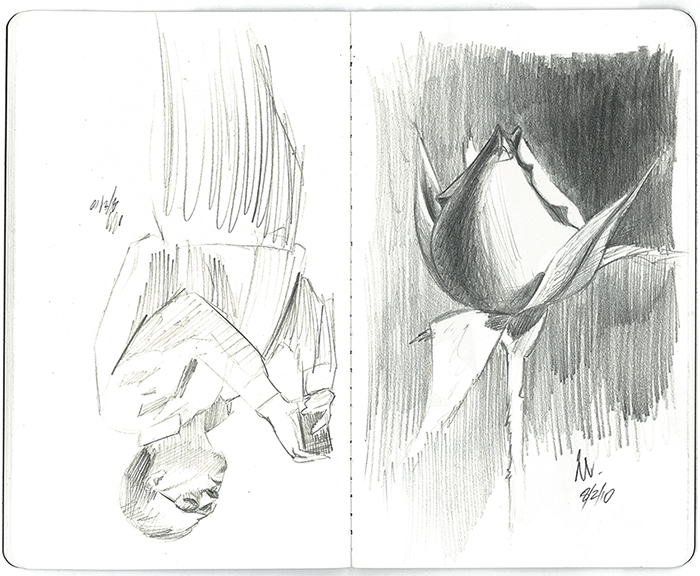
Here is another page out of my Sketchbook Project sketchbook. Again another couple of drawings from old photos. Actually three different photos.
Did the woman in profile first, then put the two fellows down below her to sort of follow her gaze. Don't you just LUV those stashes?!
joe@joewinklerart.com
JoeWinklerArt.com
Did the woman in profile first, then put the two fellows down below her to sort of follow her gaze. Don't you just LUV those stashes?!
joe@joewinklerart.com
JoeWinklerArt.com
February 1, 2011
Today’s Featured Sketch, Reference Photos, and a Quiz
I mentioned last week that I like looking at old images and sketching them. Here’s an example of that from my Sketchbook Project sketchbook.
Part of what makes using old photos as reference material enjoyable is the fact that old cameras couldn’t pick up detail like the cameras of today do. As a result the images they captured were (depending on the light situation) sometimes very contrasty or flat. That may make for a less than good photo, but on the flip side, it makes for a great photo reference by which to do a sketch from.
Why? Because one of the main challenges for many artists is to look at a subject (whether it be a landscape, a portrait, or a still life) and simplify it down to its bare basics - to really capture the essence of the subject using the minimum amount of detail. This challenge becomes much more daunting when working from photographs because it’s very easy to stare at the subject for long periods and get waaay too far into rendering the details of it. Well, old photos (especially portraits) totally solve that job for the artist automatically!
Now in this sketch, I wanted to get done quick, so I really didn’t do any measuring or fussing over technique. But had I wanted to augment this image in some way or just simply play with pencil strokes, it would’ve been very easy to do because of the way the old camera had already distilled the image to its bare essentials.
If you think you’ve seen this sketch somewhere before you’re right. It was used in the intro of a popular sitcom. My question to you is: What was the name of that show?
joe@joewinklerart.com
JoeWinklerArt.com
Why? Because one of the main challenges for many artists is to look at a subject (whether it be a landscape, a portrait, or a still life) and simplify it down to its bare basics - to really capture the essence of the subject using the minimum amount of detail. This challenge becomes much more daunting when working from photographs because it’s very easy to stare at the subject for long periods and get waaay too far into rendering the details of it. Well, old photos (especially portraits) totally solve that job for the artist automatically!
Now in this sketch, I wanted to get done quick, so I really didn’t do any measuring or fussing over technique. But had I wanted to augment this image in some way or just simply play with pencil strokes, it would’ve been very easy to do because of the way the old camera had already distilled the image to its bare essentials.
If you think you’ve seen this sketch somewhere before you’re right. It was used in the intro of a popular sitcom. My question to you is: What was the name of that show?
joe@joewinklerart.com
JoeWinklerArt.com
Subscribe to:
Posts (Atom)